Rio Grande Valley Water Crisis Warning: What Corpus Christi’s Collapse Reveals About the RGV’s Future

I conducted a comparative environmental analysis between Corpus Christi and the Rio Grande Valley using publicly available data. What I found should alarm every person living in the RGV.
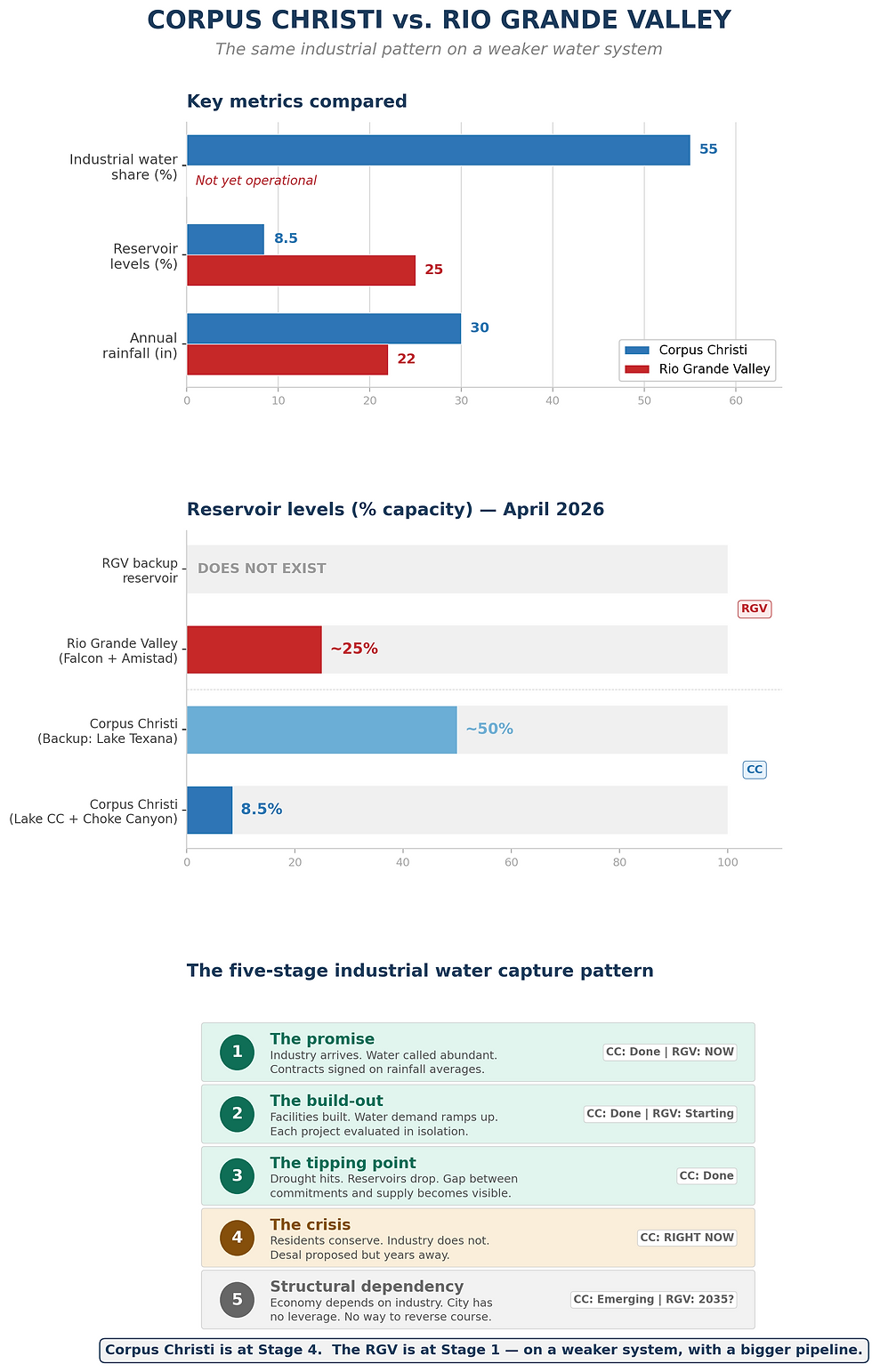
Right now, in April 2026, Corpus Christi’s two main reservoirs are sitting at roughly 9% and 8% capacity. City officials have warned that a water emergency could be declared as early as next month, and estimates suggest the city could drain its primary stored water supply by April 2027.
That is not a distant problem. That is a one-year horizon.
How Did Corpus Christi Reach This Point?
The answer is not just drought. It is the collision between industrial expansion and a fragile water supply.
Industrial facilities now consume an estimated 50% to 60% of Corpus Christi’s total water supply. Just 12 companies account for 55% of all water use. One ExxonMobil/SABIC plastics plant alone uses 25 million gallons per day — roughly equal to the amount used by all city residents combined. In 2024 alone, that one facility consumed nearly 5 billion gallons of water.
Meanwhile, residents have been told to conserve. They have been asked to stop watering lawns and cut personal use.
Industry has not been asked to do the same.
In fact, while residents conserved, industrial water consumption increased. Corpus Christi does not have a mandate requiring broad industrial curtailment, and officials have stated they cannot simply force certain refineries and plants to reduce water use because improper shutdowns could create major safety risks, including explosions.
That means the city is trapped: too dependent on industry to reduce demand quickly, and too deep into the crisis to easily change course.
The Infrastructure Fix Came Too Late
Corpus Christi discussed building a desalination plant for more than a decade. But the project’s cost reportedly ballooned from $160 million to $1.3 billion. In September 2025, the city voted to cancel it.
Now, with the crisis worsening, desalination is back on the table again.
But even if approved, it would not come online until 2028.
That is the core problem: the proposed solution operates on a timeline of years, while the water crisis is unfolding in a matter of months.
Why This Matters to the Rio Grande Valley
This is where the comparison becomes urgent.
The Rio Grande Valley is preparing to absorb an estimated $60 billion to $75 billion in industrial development over the coming decade. That includes:
LNG terminals
The first new U.S. oil refinery in 50 years
A $3.2 billion military shipyard
Data centers that could require gigawatts of power and massive water demand
SpaceX expansion to 8,000 acres
Advanced manufacturing and heavy industry
These are the same categories of industrial activity that helped push Corpus Christi to the brink.
But the Rio Grande Valley is starting from an even weaker position.
Why the RGV Is More Vulnerable Than Corpus Christi
The Rio Grande Valley has less margin for error than Corpus Christi did.
Corpus Christi gets about 30 inches of rainfall per year.
The RGV gets about 22.
Corpus Christi has a backup reservoir roughly 100 miles away.
The RGV does not have a true backup reservoir.
Corpus Christi’s water supply does not depend on a foreign government.
The RGV depends heavily on Mexico delivering water under the 1944 treaty — a system that has repeatedly faced delays and shortfalls.
Corpus Christi’s reservoirs were above 40% when industrial expansion accelerated.
The RGV’s reservoirs are already below 25% before major new industrial projects fully come online.
Corpus Christi at least had a desalination proposal in motion, even if it came too late.
The Rio Grande Valley has no major desalination project currently moving through active development.
This is what makes the RGV’s situation so dangerous. The region is not preparing for industrial growth from a position of water strength. It is preparing from a position of water stress.
The 5-Stage Pattern That Keeps Repeating
My analysis mapped a clear pattern — one that does not just apply to Corpus Christi. It is a broader warning for regions that industrialize without a full cumulative water strategy.
Stage 1: Industry arrives with promises
Jobs. Tax revenue. Growth. Officials describe water as sufficient, and contracts are built on historical rainfall assumptions.
Stage 2: Projects are approved in isolation
Facilities are evaluated one at a time. Each project appears manageable on paper. But few decision-makers add up the combined long-term water demand.
Stage 3: Drought exposes the gap
Reservoirs begin to drop. The difference between promised water and actual available water becomes impossible to ignore.
Stage 4: Residents are told to conserve
Communities are asked to cut use. Industry often is not. Desalination and emergency water supply options are proposed, but they are expensive and slow.
Stage 5: The city loses leverage
Once the economy depends on the industrial base, local leaders have fewer options. Industry has capital, lawyers, and alternatives. Residents do not.
Corpus Christi is at Stage 4 right now.
The Rio Grande Valley appears to be entering Stage 1.
And it is doing so with:
a weaker water system,
a more fragile river supply,
lower reservoir levels,
less rainfall,
and no clear regional plan.
The Biggest Red Flag in the RGV Right Now
No cumulative water demand assessment has been conducted for the Rio Grande Valley’s combined industrial pipeline.
Not by:
FERC
TCEQ
the State of Texas
county leadership
regional water boards
No one has fully added up what these projects could demand at the same time from a river system that is already under severe pressure.
That is one of the most dangerous parts of this entire situation.
Because once the facilities are built, the water allocations are committed, the emissions are permitted, and the economy is tied to industrial growth, the region’s leverage shrinks dramatically.
At that point, the options start to look very familiar:
emergency groundwater drilling,
billion-dollar desalination projects,
stricter residential conservation,
and prayers for hurricane-scale rainfall.
The Rio Grande Valley Still Has One Advantage
The RGV still has something Corpus Christi wishes it had:
time.
Not much time. But some.
Right now, the Rio Grande Valley still has the ability to:
demand water accountability before contracts are finalized,
require cumulative impact assessments before projects multiply,
build water infrastructure before the crisis peaks,
and ask harder questions before industrial dependence becomes permanent.
That window is closing.
This Is Not Politics. This Is Hydrology.
This issue is bigger than party lines and bigger than campaign talking points.
This is about water supply, planning, industrial demand, environmental reality, and public accountability.
The data is public.
The pattern is documented.
And the warning signs are already here.
If the Rio Grande Valley does not act before industrial growth locks in long-term water commitments, the region may find itself facing the same crisis Corpus Christi is facing now — only from an even weaker starting point.
The RGV Deserves to Know What Is Coming
The Rio Grande Valley deserves honest answers before the full weight of industrial buildout arrives.
It deserves to know:
how much water these projects will need,
where that water will come from,
who gets cut first during a drought,
and what happens when industrial demand collides with a shrinking river.
Because once that collision happens, it may already be too late.
Share this. Send it to your city council. Send it to your water board. Send it to your state representative. The RGV deserves to know what is coming.
Download the full analysis here.


Comments